Showing posts with label Witches Look Up. Show all posts

Sunday, July 30, 2017

The Trouble with Gifts

Many years ago, I had a fundamentalist Christian tell me that she stuck to the 'Biblical' position of sex as gift; that statement struck me as having something wrong with it at the time and it has taken me over two decades to realise just what it was made me so uncomfortable about it.
For a start, you will notice that I have put inverted commas around her assertion that her opinion is of the Bible. If you actually read what the bible has to say about sex, it is presented as far more of a problem for humans, and there is much more concern to regulate humans' sexual behaviour. My humble opinion is that the actual Biblical position on sex is therefore that it is a base urge which is to be practiced only in certain ways, to be contained, and that this is the law of God. I'll probably get hate comments for saying this, but in my experience, when a Christian describes an opinion as 'Biblical', what they are actually saying is that it is their opinion and they have the backing of the Old Man Upstairs, who wrote it in this here book.
The other thing that made me uncomfortable about her position is that I don't like the idea of things being gifts, purely for the reason that it tends to put the emphasis on the giver, rather than the gift or the recipient. Anyone who has had any contact with Christian culture will have been struck by this dynamic - actually everything is God's gift and he is to be thanked. This idea takes us straight to the major problem at the heart of Christian theology - why bad things happen to good people, a question they get themselves in some incredible contortions to try to solve.
The problem of gift is illustrated by the picture which illustrates this post. It is the foundation stone of the library in Selly Oak, one of several 'Carnegie' libraries in Birmingham. Andrew Carnegie is recorded as the second wealithiest person in modern history (he made his money through industry) and made a practice of endowing libraries. His practice was only to give funds to places where the recipients would also put resources into the running and maintenance of the libraries, and so his incredible wealth meant that he not only has his name memorialised the world over, it means he also got to control the places to which he gave libraries, for time to come.
My problem therefore with gifts is that they glorify the giver but also allow the giver to retain the power over both the gift and the recipient. This goes for the matter of sex, wth which I started this post, just as much as it does for any Carnegie libraries. I had come across witchcraft at that point, although was very early in the series of traumatic events which propelled me into the craft, but even then I was uneasy with this top-down dynamic which I now recognise as reinforcing a dynamic of power and dependence.
How to alter the 'gift' dynamic? Naturally I don't have an easy answer to that one, but suffice to say you won't tend to catch the Hound thanking divinity for stuff. This may seem terribly ungrateful but that is because I don't see myself as her specially favoured recipient of favours, nor even see the things I have as coming from her. I don't have any easy answer to the question of why I have the things I do, but since I don't primarily see them as the gift of divinity, I have effectively ducked the question of why she doesn't give them to other people. Yes, I am relatively prosperous and privileged, but that is for an incredibly complicated set of reasons - to reduce these reasons to a gift of divinity is to negate the injustices that have led to where the world is today. To glorify the giver is a slap in the face to the people who have been disenfranchised to allow other people's prosperity.
At this point I am rather grinding to a halt with my original thought - which was why I am uncomfortable with the idea of things as gifts. What therefore is a witchy way to look on these things? I would like to propose a philiosophy at this point, which will synthesis all the difficult questions of rights, advantage, probably take account of several world religions, and end by creating a world where everybody gets on and there is world peace. But you've guessed it, that's way beyond me and everyone else throughout history. However, I'm a witch to my fingertips so wouldn't really claim to have the old man upstairs on my side, and also don't really want other people to do as I say. I am therefore going to steal a philosophy from Tristram Shandy: ''So long as a man ride his HOBBY-HORSE peaceably and quietly along the king's highway, and neither compels you or me to get up behind him, - pray, Sir, what have either you or I to do with it?'
Image credit: https://billdargue.jimdo.com/placenames-gazetteer-a-to-y/places-s/selly-oak/

Saturday, August 29, 2015

Narcissistic Mothers & the Cock Tease

The lovely Inexplicable DeVice commented recently on how prolific I am being. I'm pleased that he was apparently referring to my blog posts rather than anything else (if I was straight I would probably have to dejob myself to avoid crippling maintenance payments by now), although of course he hit the nail exactly on the head in commenting that the urban hedge must be fertile. And of course that is exactly what is happening, I'm sitting nicely in my hedge and the growths, challenges, and spurs that come with fecundity are coming thick and fast.
A major way my life has developed even this week is that I made the mistake of reading through an internet forum about narcissistic mothers, while trying to get to sleep. I didn't sleep much that night at all, because finally I had found a bunch of people who were describing my childhood and ongoing relationship with my mother without having been there. A friend commented that it seems a pity it has taken me so long to realise that narcissism is what has crippled my relationship with my mother, and of course it is because nobody ever says to you 'I am going to treat you in a totally personality disordered way'. My own case is also atypical because as an only child I had to be both golden boy and scapegoat at the same time: no wonder I've always felt that whatever you do for my mother is never enough! I finally have the explanation of why my own account of life with my mother differs from the experience of family friends, is that the narcissistic parent projects the dream onto the outside world and so everyone else sees the wonderful mother who is a pillar of the church and never even realise the brooding atmosphere in the house that you never know what is coming next. This explanation also accounts for my failure to negotiate a sensible relationship with her: she would either say that my personal boundaries were unreasonable, or else agree to them and just ignore them. In fact the common experience of the children of narcissistic parents is that actually the only way to deal with them is to break off all contact, which is what I have been forced to do, with the resultant tirade of harassing phone calls and bad mouthing that she has undertaken.
Another friend very kindly (we have this sort of relationship) tells me sometimes that given what my mother is like it is surprising I haven't ever completely gone off the rails (I think the only child thing actually accounts for that – it means the narcissistic parent actually has a dependence on the child so that she can never really scapegoat). Of course where this leaves me as an adult is that I now know there is no point ever hoping for an apology from my mother, or a deathbed reconciliation on any terms except hers alone. There is truly no-one else in her world and I have to get on with my life as best I can. This may all sound very tragic, but all of this is stuff that I have been living with for decades, and I am actually relieved to have an explanation for what has gone on.
Naturally such a dysfunctional mother does create a legacy for the child. For a start I have the INFJ personality, one very easily open to the kind of invalidating parenting I am talking about here. I have also read that the INFJ personality is the one most frequently found in people who have been emotionally abused. Be that as it may, a further development in my life recently has been the extent to which I have realised that I am largely an older gay man with my shit together. I have mood and addiction issues, but they are both in hand to my satisfaction and my life is about as sorted as it is going to be.
I've commented here many a time about how once you deal with a particular situation it keeps on repeating for you, and I actually have the Cock Tease, whom I have posted about several times recently, to thank for this new insight. I have been pondering why the friend I talk about above, who also knows him, perceives him really quite differently from me, and of course the reason is that he shows her the golden boy. He has shown me the real him in fits and starts over a period of years. At this point, he is out of my life about as permanently as it can ever be, and his number is blocked. I have commented before that I lionise him, and actually the really funny thing about this is that I do. I genuinely think he is wonderful. But the reason I can have no contact at all with him is that he cannot cope with the fact I lionise the real him (he's had some things happen to him, fairly guaranteed to screw you up for life). He can't cope with the real him, and so comes and goes, stamps his foot, projects the stuff he doesn't like about himself onto me, moves house frequently, changes jobs all the time, drinks ridiculously to excess, etc.
Then I was talking to another mutual friend, who told me that he commented that he induces vomiting, and that she really believes he does have bulimia. This didn't seem right to me, but lo and behold, when a friend and I looked close up at a photo in which he was showing his hands, there it was: Russell's sign . It was after I joked with him about him saying that he went really funny on me, so he obviously let that slip by mistake and doesn't want it known. Given his complex personality structure, I have to accept that I can't go there until I have some sort of satisfaction that his personality is better integrated.  
But Hound, you may be saying, it wouldn't be like you just to accept that something is so without having a good meddle. Damn, discovered. I did suggest to my friend that we do a healing spell on him (I'm good at healing, me, although it would have worked faster if he'd had sex with me), and she almost visibly blanched on the other end of the phone and commented that it would take some doing. So while I'm no further on than thinking I might do something about him magically, it is necessary to do some spying.
His general state of health at the moment: Page of Pentacles. I would interpret this as referring to his lifestyle, his attempting to live like one of those youngsters who think they can drink and so on, without any consequences.
The effect any induced vomiting is having on his health: 6 of Pentacles. He's OK for the moment, but he's literally giving it away, and can't do that for ever.
The effect his drinking is having on his health: VIII Strength. Since this is a Major Arcana I would interpret it as meaning that he is an alcoholic, he is dependent on it and has lost any battle he has attempted with it, so that it will sooner or later take over.
The effect his continuing to drink as he is will have on his life: 9 of Swords. I previously got this card for how he saw me in the light of me finally cutting him out completely (I've cocked it up again), so I would interpret this as meaning that his life will start falling apart (relationships, friendships, jobs, etc) and it will reinforce the script which underlies a narcissist's golden image that he's fairly crap.
The manner of his death at this rate: 10 of Wands. My feeling is that it will not be sudden or even soon, but I have an awful feeling that he will do something he regrets when drunk, and either have an accident or get HIV or something, and that will put him further on the skids.
What I can do to help: VI Lovers (I don't believe this). I'm inclined to interpret this as me so far doing the right thing by hopefully giving him a shock. Of course Lovers doesn't just mean lovers, there are elements of the voice divine and parenthood, and growing up involved in it. I may look out a growing up spell. Watch this space. I'm guaranteeing you haven't heard the last of this!

Friday, August 22, 2014

Walking in Birmingham

It's quite difficult, I've found to get to know a city, so after considering a few more psychogeographical techniques, I'll publish all the walks around the city I know, purely as a public service. I'll try to post this as a separate 'page' for reference as well, *when I've worked out how*.
Psychogeographical approaches
The city centre streets of Birmingham are not, in my experience, suited that well to some of the classic psychogeographic techniques to get lost. Following a pattern such as first-right-second-left tends to end up either in a dead end or going round in a circle too much. A technique I like a lot is the one that in its classical form means drawing round a glass on a map, & walking round the line you've drawn, as close as possible. I find paper maps too much hassle, so I like to translate it as downloading a map & drawing a shape on it on a computer (I like the map at http://visitbirmingham.com/explore-birmingham/guides-and-maps/ It's a pdf but can be turned into an image file with a screen capture & then kept on phone or mp3 player). In this technological age there is even an app (that works online, you don't have to be iphone or android) to help you get lost at http://deriveapp.com/s/v2/
There is another great psychogeographic tradition, of navigating a place using a map of somewhere else. I personally also like using maps of the past. There is, for example, the Westley street plan of 1731, although it needs a rotation for modern eyes (http://upload.wikimedia.org/wikipedia/commons/8/8b/Birmingham_-_Westley_Map_1731.png). More recent history is encompassed in the proposal for the inner ring road (which isn't quite what was built (http://i39.tinypic.com/wasqoy.png), which gives an impression of what might have been.
Books
Noszlopy & Waterhouse's Birmingham Public Sculpture Trails (Liverpool University Press, 2008, ISBN 1846311349) does exactly what it says on the tin, & following public art rather than roads or buildings makes an interesting alternative way of exploring.
Foster's Pevsner Architectural Guide to Birmingham (Yale University Press, 2005, ISBN 0300107315) is starting to show its age a little but is the one book I would tell people to get about Birmingham. It contains as much history as architecture. He also has routes around the Jewellery Quarter & Digbeth.
A third book I like a lot is Smith & Bannister's Haunted Birmingham (History Press, 2006, ISBN 0752440179), with which a good ghost walk could well be constructed.
Websites, leaflets & trails
The Visit Birmingham website has a digest of guided walks, tour guides, useful links to things like the Big Brum Buz & so on, with a less...eccentric slant than my own: http://visitbirmingham.com/what-to-do/tours-sightseeing/on-foot/
A major way to explore a place is to follow themes in its history & fortunately planned walks aren't lacking for these in Birmingham's case.
For the historically-minded, I like the walk through time on the BBC website a lot 'On this Walk Through Time in the heart of the city, you'll find out about Birmingham's past as a forest, a swamp and underneath an ice sheet hundreds of metres thick. Then you'll walk right up to the present day, through Birmingham's history as a settlement and a thriving hub for industry. Keep your eyes peeled and you might just see some rare birds!': http://www.bbc.co.uk/birmingham/your_birmingham/walk_through_time/index.shtml
The Birmingham Grid for Learning website (bgfl.org) has a number of trails created from an educational point of view by local schools.
There is a Lunar Society walk that can be downloaded at http://www.bmag.org.uk/news?id=318
Two 'pavement trails' round the Jewellery Quarter (http://www.jewelleryquarter.net/visit/things-to-do/pavement-trails/) will explain those funny things in the pavement in the quarter. It is said that you're either a Jewellery Quarter person or a Digbeth person, & trails are also available on the other side of the city centre (http://digbeth.org/trails-and-tours/). Similarly, although it's not an actual walk all laid out, you could follow the author's footsteps in a Peaky Blinders-themed walk round Bordesley (http://www.birminghamconservationtrust.org/2013/09/22/peakyblindersbordesley/)
The Connecting Histories website has four trails themed on suffrage, Joseph Sturge, & Judaism, at http://www.connectinghistories.org.uk/exhibitions/trails.asp
In terms of leaflets, Birmingham Civic Society do a guide to heritage buildings - I've seen it in the library, so no worry that the information place on New Street is now closed. And the council do or did a cycling & walking map of the entire city.
It is hardly possible to visit the Venice of the Midlands without exploring the canals, & canalrivertrust.org.uk have downloadable maps & an app. In paper terms I've always liked Pearson's Canal Companions, & the First Mate Guides are now downloadable for a donation.
If you'd like a walk in the company of the neighbourhood witch, my only original contribution is my essay on urinals & other conveniences (http://houndofhecate.blogspot.co.uk/2013/04/spirit-of-place-cast-iron-urinals.html?m=0); I had a little hand in my version of it, but the Green Man trail was originally the work of Anthony Hayward (http://houndofhecate.blogspot.co.uk/2012/12/the-green-men-of-birmingham.html?m=0).
Outside the City Centre
For greener walks, the council website has a number of 2km & 5km walks in parks: http://www.birmingham.gov.uk/walks
The Birmingham Museum & Art Gallery site has a downloadable leaflet about the Tolkien trail, if you're keen on little men with hairy feet: http://www.bmag.org.uk/sarehole-mill/tolkien
There is a signposted route along the valley of the River Rea from its start up to Cannon Hill Park (where is becomes much more difficult to follow unless you follow the glimpses in the city centre): http://www.riverreatrail.org.uk/index.php?option=com_content&task=view&id=69&Itemid=139

------------------


Sunday, August 3, 2014

Spirit of Place: Bearwood

One of the things I wanted to comment on when I had my difficulty writing about witching in the city recently, was the effect that cities have on the surrounding areas. They both leach off their surroundings but also spread the goodness around in terms of employing people from outside the city, & so on. The voracious appetite of cities, gobbling up the towns & villages nearby into conurbations, makes for an attitude of denial or even resentment in the surrounding areas. For example locally it is joked that Sutton Coldfield doesn't realise it's in Birmingham. Solihull (still a separate borough) put the scuppers on another recent proposal to create a Greater Birmingham. My own mother, three years before it was brought into Birmingham, was born in the suburb of Quinton & so grew up in Birmingham. She is adamant that she's not a Brummie. She's a Brummie, just in denial.
Another place locally that's in the hinterland between Birmingham & somewhere else is Bearwood. I've lived there for 17 years & like it very much, although the plan remains to move into the city, more because of Bearwood's associations for me than because of not liking it. If I should forget myself in this post & comment on how native Bearwoodians are off their heads (whoops, there I go), it is merely out of affection. Some people call Bearwood part of Birmingham - it has a Birmingham post code & Birmingham phone numbers, but the authority you pay your council tax to is - whisper out of embarrassment - Sandwell Council. In the interests of fair comparison, I must mention that Birmingham council has looked fairly ridiculous recently, its childrens' services are a disaster, did they really think they'd get away with unequal pay for women, & why didn't they spot the trojan horse thing happening? On the other hand I'd still rather be in Birmingham than anywhere in Sandwell, or indeed the Black Country. None of my dealings with Sandwell council have inspired confidence, although the bin men have been much better since it went out to private tender. I just don't chime with the spirit of place of the Black Country. Which brings me nicely to the spirit of place of Bearwood, a liminal, magical place if ever there was one.
The reason for that is what is now Bearwood was originally in three counties: the tree marked by a blue plaque on the junction of Three Shires Oak Road was said to have its roots in Staffordshire, Worcestershire & Shropshire. (The history of Bearwood is taken from Mary Bodfish's articles in the Bearwood Gem of August 2011, October 2011, January 2012, & March 2012, in places with my own spin put on it as usual). The division between Wigorn & Salop dates back to William the Conquerer dividing the manor of Halesowen between two of his barons. The first mention of the place as a route is in a grant of land by the Abbot of Halesowen in 1278, which mentions 'the King's high road from Harborne to Smethwick'. The area was an important artery between the parish of Harborne & the developing area of Smethwick. The name 'Bearwood' is first recorded in 1783; it was previously referred to as 'near the sign of The Bear'. Bodfish is confident the public house of the same name gave its name to the area: there has been a pub there for over 300 years, although the present gorgeous building with its terracotta bears only dates from 1907. The oldest building standing in Bearwood is actually the shop on the Bearwood Road next to St Mary's. Earlier depictions of The Bear show a very different Bearwood - hayricks in the field nearby, & Sandon Road was called Bear Lane. The inn has been a real inn for most of its life, & at one point even housed a court house. At the time of writing the scaffolding is up again - it does badly need a thorough going-over above street level, although a 1970s refurb removed the original state of the ground floor. Look up, that's the motto, in architecture as in witchcraft.
But this is a witchcraft blog, so let's make a point of seeing rather than merely looking. The mere fact of it being on a truly ancient crossroads is as redolent of magic as anything could ever be - crossroads symbolise & function metaphysically as places of change & decision. The fact of Bearwood being also in several other places yet not quite of them - including in Sandwell yet appearing to be in Birmingham - is redolent of the circle as a place that is not a place. If the witch is formed by the hedge, Bearwood forms some changeable witches, some changing witches, some changed witches. It can be quite an unstable place, in its underlying spirit. To be born & brought up in this hedge is to be exposed early to many conflicting energies, thus the natives tend to be a bit...eccentric.
Yet the bear thing gives quite a different energy, a strong, protective, defensive energy, that only appears when it is needed. In fact the image - & therefore evocation of the spirit of - the bear is literally everywhere in Bearwood. And I don't just mean a big hairy man, well perhaps I do, oh bugger, I've gone native.
------------------

Friday, May 16, 2014

The Woodman, Eastside Park

We had lunch at The Woodman today, an old pub with a rather chequered history, that has re-opened in the past year, since Eastside Park was opened. It is a seriously sexy building, one of Birmingham's classic terracotta-and-tile pubs. We sat in the posh bit, the former smoke room, where there is a bell push for service above each table. Push ours as I could, service didn't come to the table. The room has the original tiling & essentially original set-up & furniture. The tiling can feel slightly cold, but to a magical person that building is one hell of a history book. I mean, seriously, you have to see, although I feel she has a preference for gay men!
The other history lesson in that building, that I only realised after I'd been a couple of times, is that the room we sat in used to have a plaque in to commemorate the visits of Peter Sutcliffe, the Yorkshire Ripper. He was a lorry driver in the 1970s & used to go the Woodman with other lorry drivers. Who knows, I could have been sitting where he used to sit!
Another strange thing was that the girls at the table next to us all left around half of their - not-excessively-large - meals. Judging by the talk of portions the Hound (over) heard, I would guess this was for reasons other than dissatisfaction with the food!
------------------

Monday, May 5, 2014

Witches Look Up: My Suspicion of Bank Holidays

Today is a 'bank' holiday in Britain, an excuse for all sorts of 'traditional' eccentric goings-on (See http://m.bbc.co.uk/news/uk-england-27205244). In fact so many of the apparently old traditions of Britain take place on Bank Holidays that it's easy to be taken in by the Merrie England lure of this ridiculous fantasy.
The reality is that up until the Bank Holidays Act of 1871 there weren't any. None. Of course I'm probably over-egging the cake, by referring solely to the holidays on Mondays. Good Friday & Christmas day were common law holidays on which any business could legally be deferred to the next day, from before records begin. There is also the way in which the Christians have messed up the Day of the Sun permanently. Even from 1871 there were only four. The act was passed by the Liberal Sir John Lubbock, & a grateful populace called these four days 'St Lubbock's days' for some time after 1871.
The historical rat that you can smell here is of course the date at which the act was passed & the fact the populace was so grateful: what marks these holidays as permanently modern & totally not ancient is twofold: the Act was after the seachange to working life that was the Industrial Revolution, & the simple fact that in a traditional agricultural economy you simply don't get days off.
In terms of modern economics, being a purely city person who can't sleep in the country because it's too quiet & as a child got spooked on a road without traffic lights, I really don't have a dog in this fight. I have *no* aspiration to return to, or even interest in, the way of life before the Industrial Revolution (the contentious historical question of the nature of the change in the Industrial Revolution is waaaay beyond the scope of this post). I am a city person.
I do question the motives of those who are taken in by the pseudo-traditions that go on on Bank Holidays. I suppose it's the whole thing of the 'imagined village' - life at the time of the Industrial Revolution was horrific for the workers, leading to a rosy view of the pastoral idyll that had gone before. We humans really like to have an imagined cosiness to retreat into. And I suppose this is my real problem with the bank holiday revels - the *reason* people were grateful for them was that their lives were horrendous the rest of the year.
Strangely one of the revels in the above link - the sweeps' festival in Rochester - would not have been protected by law as a holiday because its original incarnation died off after the Climbing Boys Act of 1868, so it actually predates the Bank Holidays Act. It took something like forty years for it to die off before being revived in the 1980s.
Surely I can't be the only person this whole thing leaves with a nasty taste? I'm actually quite fortunate - since I work shifts I work many bank holidays but get them off in lieu at other times, so I actually wind up with more days that I can take when I ask for them, than I ever would if I worked in an actual bank. So I suppose I actually have as close to the ideal for me personally as I'm ever going to get.
However Bank Holidays remain for me the memorial of how work has taken over people's lives since the Industrial Revolution. Nothing wrong with work, it is one of the ways to self-respect & the establishment of a willed life. What devalues modern work is its disconnect with our actual lives & values - work for someone else is always tied to money, & as such is devalued, compared to working for the thing you're doing. Nor am I inpressed with self-sufficiency, or a back to the land philosophy. I am impressed by the Moneyless Man (pictured - even if he isn't a witch, he at least dresses like one) for his commitment to doing his will & his frankness about having to make some purchases before he started. I am aware that I'm both trying to have my cake & eat it by my uneasiness at the Industrial Revolution & the modern monetary economy it spawned, & also my dislike of the genuinely traditional life that preceded it. I think my real discomfort is the idea that people were *allowed* to have Bank Holidays off (by the people in power), & pathetically grateful because of their awful working conditions (gifted to them by probably the same people, ultimately) rather than any possibility of choice over work & leisure. Nor do I buy the idea, frequently repeated by second-wave feminists, that life used to be one long holiday or festival, which to me is a pseudohistory. My discomfort at this remains, & I think will not go away.
------------------

Thursday, April 10, 2014

Hidden City: Dingley's Passage & The City Under The City

This is a post about an apparently insuperable problem in the history of my personal Hedge: it isn't solely an excuse to make rude remarks about getting to the bottom of Dingley's Passage if it kills me, so I'll get that out of the way right at the start. I discovered this place purely by chance on the way somewhere else: surely the best way to find somewhere, although I can see, like the hound I am, I'm going to have to annoy this one 'till I get to the bottom of it.
You see there's a particular difficulty in the exploration, history, & psychogeography of Birmingham, which is caused by the spirit of place itself. A Birmingham 'thing' is the mania for demolishing whole areas of the city every few decades & rebuilding them in the fashion of the time. This is not even something confined to the post-Second World War reconstruction, although that is perhaps the most apparent example. Another example would be the flattening of a whole swathe of city to create Corporation Street in the nineteenth century. A more minor example is the current relaying of lines for trams. I say relaying because actually they're being put down where the trams used to run anyway, before the rails were taken up on the perfectly reasonable rationale that things that run on rails are inflexible to say the least. The Hound's prediction is that in around a decade the present disarrangement of public transport (in bus form)  to several stopping points around the edges of what was the city centre in the days of the inner ring road, will be decried as ridiculous & buses will run down Corporation Street again.
The point of this lengthy digression from Dingley's Passage (it's not over yet, I somehow can't break myself of the habit of only getting to my actual subject in the last paragraph of a post) is to make the point that as a rule only the most recent reincarnation of the city is visible. Not that there is nothing old here: the soil under the Eastside Park has been analysed & shows evidence of deer farming in the Middle Ages. Even at the height of the concrete jungle days you just had to know where to look to find the history of all sorts of times. I suppose this inverts the 'witches look up' motif, to make it 'witches look down' or perhaps even 'witches look beneath'. This is necessary because in the case of Birmingham, there are frequently *no* indicators of what was there before (Dale End is a good example of this, see http://peteashton.com/2007/01/before_the_concrete_collar/ which has links to a further good collection of before pictures). The only other place I know of that changed so much is Sheffield: I can't think of anywhere else with such a new building mania. Coventry doesn't count because it came from necessity rather than a local tradition of frequent demolition & rebuilding.
In the case of the place I'm writing about today, it isn't the place that's hiding, it's actually any history or origin. The first picture shows the actual place - it's just an open space, beside a car park, leading to nowhere, but tarmaced & signposted with a very new-looking sign. It's on the corner of Moor Street & Albert Street: Albert Street shows its Victorian origins to a tee, & I was hoping Dingley's Passage would prove to be one with a history, like Christchurch Passage. But I was to be disappointed. The first thing I did was to search on Google: the passage appears on Google Maps, but nothing. No evidence of any history at all, just people wondering online the significance of Dingley's Passage. Exactly as I am doing here.
So I went home & looked on my 1901 Ordnance Survey map of the city centre (Witches look things up). It's not there. So, heart sinking, I went to the Library of Birmingham (Witches will not beaten by a mere street name). Anyone who's seen the local news recently will know that it's still not up & running ('Shambles...' Thundered the headline in the Birmingham Post), the staff are few & far between, etc. So I did something that normally never fails - picking books on the open shelving that looked hopeful & looking in the index for Dingley's Passage. Nothing. Their larger scale maps (for 1887, a snapshot of that corner is the second picture) also do not show it. It isn't even as if that corner has been too much altered: the inner ring road was right there, but I believe the road plan just there to have remained unaltered.
So then I had to tell the woman (who clearly normally works in a different department) that I needed Kelly's directory. Once she'd shown to the ones for Dundee & I found the Birmingham ones myself, I made the unsurprising discovery that Dingley's Passage does not make an appearance (I picked the 1958 one at random).
I do, however have a tentative theory. What appears on the 1887 map is one of the old courtyard buildings (they've all gone now except the National Trust one). My theory is that Dingley's passage could have started life as the passage marked under Victoria Buildings or the one into court 23. I wouldn't go to the stake for this theory, since Dingley's Passage seems to go at a different angle to either of those. It retains its mystery as to its origins & the reason for its continued existence.
There is a possible connection (quite likely, given the unusual name) between the Passage & a hotel that stood on Moor Street called Dingley's Hotel. Phyllis Nicklin's photograph of it in 1960 is the third picture. Memories abound of this hotel - it was dead swanky, frequented by businessmen & the great & the good. It is said to have been built c.1745. The memories of it may not quite agree with the reality - I notice from the Birmingham Post Year Book & Who's Who of 1960-1 that it had only 16 bedrooms - the second smallest of the twelve hotels in the city centre - & was recommended by neither the AA or the RAC. At the other end of the scale the Grand Hotel had 220 bedrooms & was recommended by both.
I am therefore forced to consider the name Dingley by itself. They are obviously quite some family locally: even today there are no fewer than nineteen professionals with this relatively unusual name on linkedin in Birmingham (I can't reference this, I can't get on the site, but that came at the top of a Google search for <Dingley Birmingham>). There is or was also an award & badge manufacturing firm in Warstone Lane.
On the principle of the most simple explanation being the most likely, I'll have to postulate that one or more of the Dingley family/ies either owned land around there or was even a leaseholder on the buildings. I'm fully expecting now that the history of this place will in the near future leap into my lap - maybe even from a visitor to this site - purely because I've dug down below the surface, so have no doubt I've disturbed whatever is down there.
------------------

Sunday, March 16, 2014

Avoidance of the p-word, a drift, & encountering underpass Birmingham

It has taken me this long to realise that I have so far avoided calling my approach to the Hedge, the spirit of place, by the name of psychogeography. Witches tend not to be thought of as psychogeographers, but we must be, since it is defined as �the study of the specific effects of the geographical environment, consciously organised or not, on the emotions and behaviour of individuals� (http://thoughtsfitsstarts.blogspot.com/2011/08/godfathers-of-soles.html?m=1). This came to my attention, chatting to the chiropodist the other day. I like to break people in to my weirdness gently, & I thought I would do that by telling him the classic technique of going round one place, using the map of another. He looked at me in horror, wanted to know where that would ever get you, produced a map of Barcelona out of nowhere, which he thrust into my hands & demanded to know how you'd find your way around Birmingham with that. This action raises several questions for me: the answer to one of them is that he has never been to Barcelona, but would like to go. Keeping a map of a place that you would only like to go to, & telling me to *think* that my feet will get better, to ensure they do, are actions only marginally removed, in my mind, from magic. Anyway I opened the map: I don't know what map it was, I certainly can't find one online of Barcelona that looks like it, but Birmingham's Inner Ring Road appeared on this map clearly, & even he had to admit that he could see it when I challenged him.
I think the reason I've avoided calling what I do 'psychogeography' is that when it comes down to it it is a load of poncey nonsense. In fact it's right up there with literary theory & witchcraft! There have apparently been attempts to turn psychogeography into a science, but of course it simply isn't in any conventional, repeatable, empirical sense. Of *course* this creates a crossover with witchcraft: much of the point of the modern drawing on the witch figure is its slipperiness, it is not susceptible to a single simple definition & so draws on elements of lots of things, including ones that are clearly fictional.
Defoe's Journal about the plague year is a) clearly fictional & b) written some years afterwards, but has become a key text of psychogeography. The point here is not only the effect of the city on us, but our conceptualisation of the city, in Defoe's case a reconceptualisation prompted by a disease process. Leaving aside that much of the writing about psychogeography focuses on London or Paris, Birmingham is actually also a perfect city for it: it is a city that not only changes fast, but that lends itself to personal maps & identifications. You always have your own Birmingham, created by you.
My normal custom is to go on a more traditional derive, sometimes aiming for a place & wandering around. Today I went on a  more structured wander, using a technique where the walk is more defined beforehand. The ancient mystical technique used here (dating back to the 1990s) is to draw a circle on a map with a wine glass & walk around staying as close to the line as you can. I did it in an updated way by downloading a map (credit: visitbirmingham.com) then drawing a shape on it using Microsoft Paint. I arbitrarily chose a heart, & the green lines were some possible routes that I drew in, since I don't really know that side of the city.
I tried to stay as close to the heart shape as I could, allowing myself to be sidetracked if I saw something interesting but always trying to return as close as I could to the heart. I tend to think of that area behind Aston University as 'old' Birmingham, because it's been less affected by the re-redevelopment since the nineties. In fact there was a real concrete jungle experience in the shape of the underpass at Ashted Circus (pictured facing towards Eastside), forcing me to revise my previous idea that Holloway Head was the only traffic roundabout with a garden in the middle left in the city centre, although Ashted Circus was actually on the middleway.
This walk was interesting in comparison to the more conventional derives I do, since it imposed a form on what I was going to do, changing the dynamic to one where I had to stick to a plan, that was nonetheless completely arbitrary to begin with. Because I took a map & drew a shape on it it also made me go somewhere I have only seen from a bus before, thereby opening me up to a new experience. The area I walked through is on the one hand largely industrial, yet on the other I skirted the science park, Aston university, Millenium Point & Birmingham Metropolitan college, making it pretty academic too. I didn't like the way it felt, if I were to be absolutely frank, but I think only because it feels to me like the spirit of place is unloved around there. The industrial & educational uses of that place are in a sense all too transitory - people go there for a time & leave, meaning the spirit of place is unloved & unnurtured. Even the few residential buildings are for students so it is terribly transitory.
I'm still determined to superimpose the map of 1731 on a modern map & walk that - the only reason I didn't do it today was it gave me too much of a headache trying to do it last night. But I definitely will do this shape on a map technique again. Drawing on the more occult aspects of psychogeography, walking a sigil in the city, or mapping a derive & turning that into a sigil, could both present interesting potentials in exploring & interacting with the spirit of place.
------------------

Sunday, February 16, 2014

Spirit of Place: Paradise Place

It is axiomatic that if a place has a name containing such words as paradise, heaven & so on, it is going to be awful, & Birmingham's Paradise Place, which is actually underneath the not-so-bad-in-comparison Paradise Circus, is no exception. I went there fortuitously, since I actually meant to write a post about ghost signs today, & thought the Jewellery Quarter would be an ideal place to see some. On the way there on the bus I realised that I'd never explored the area just to the right as you look at the back entrance (on Great Charles Street Queensway) of the museum & art gallery, so made a mental note to do so if my search for ghost signs should prove fruitless which it did.
This is going to be a picture-heavy post, with a mixture of archive pictures & my own, but remember that in the next couple of years *nothing* on this post will be there any more. The central library is exempt from listing until 2016 so it's got to be demolished before then, unless the council want to be saddled with it for eternity, & with it will go the rest of that 1960s development that went horribly wrong. You see, this is the point, that this is part of a plan for that side of the city that is not what was planned. The first picture shows city architect John Madin with the model of the plan for that part of the city. Even that wasn't the first uncompleted plan, an earlier plan had fallen through, leaving Baskerville House & the Hall of Memory the only parts of it ever built. If you are a brutalist architecture & want to see John Madin's work, you'd better rush to Birmingham soon, because his buildings have a strange habit of getting demolished. As you can see from the picture there was a huge leisure & commercial plan for that whole area. All that was completed was the library in the centre, with on one side the school of music & a shopping arcade, leaving the gap under the inverted ziggurat empty. Apparently for some time after the central library opened in 1974 there was only a scaffolding bridge from Paradise Circus over the road to Broad Street. The gap was glassed in & shops constructed in the 1980s: this is bemoaned only by the hardcore fans of brutalist architecture. The second picture shows it 'before', & also shows an example of the concrete staircases so beloved of 1960s architects.
On the other side of the library is the bit where it went horribly wrong & was not really capable of being papered over in any way. Naturally service routes into the development had to be provided, there was even a plan for an underground bus station (presumably just as horrible as the one in the Bull Ring). I suspect that where I went today was what would have been part of the bus station. I feel it also explains why coaches have always stopped on that strange island near the college of food: because it was going to be a public transport hub that never happened.
The third picture shows what you see of Paradise Place as you go past on Easy Row, & another brutalist staircase. I have always always wanted to go up it & see where it went. Presumably a lot of other people have also wanted to since it's fenced in with wire, & the opening at the bottom is securely boarded up. I have seen the building that goes over the road there described as the council house extension (the fourth picture is a newspaper cutting about the construction of that area): whatever it is it looks grim, dirty, & semi- or even unused.
I entered Paradise Place by the staircase (fifth picture), which is what attracted my attention in the first place. I love the way there is a sign telling you what this part of the city (where nobody but the curious & homeless go) is called: ironic really to tell you to come to Paradise, invite you, then find it such a dive. A long concrete bridge thing (sixth picture) takes you behind the staircase I would so like to explore to an area (seventh picture) where apparently there used to be fountains in the seventies, but they're long gone & the area is now simply grim. It is evident that homeless people sleep there (& further down). Now here's a strange thing, since this is a spirit of place post (I hadn't forgotten), I never once felt threatened in Paradise Place, even though it's exactly the sort of place (underground, dark, neglected, hidden corners) that ought to be terrifying). Perhaps it's simply that nobody goes there, but it seems I'm not the only one to perceive it as unthreatening, as witnessed by the homeless people sleeping there. The sense of seclusion is increased by a nearby subway being gated off (seventh picture): I'm sure I have passed by that gate on the other side with no idea that it was accessible from both sides. Conversely there also a sensation in Paradise Place that it is somewhere you 'shouldn't' go, or rather it gives out mixed messages about its status. There are optimistic signs giving its name even in the completely dark part (eighth picture), presumably a legacy from when this place was intended to be part of a bright new development. Perhaps that's it, Paradise Place gives out mixed messages because it was intended as an optimistic 1960s development, it was intended for public use. This bright new 'spirit of place' was cut short by the fact it was never completed as intended: those kind of buildings always has a sad feel about them, & remain as monuments to (often) one person's grandiosely impractical vision. As the seventies & eighties progressed & fashions changed, Paradise Place's fortunes would have fallen further. I mean, the reason it's still there is nobody goes there, so the land owner (presumably the council) has never been embarrassed enough to rehabilitate it. Interestingly, though, its fortunes have never fallen far enough for it to be abandoned completely. Access was easy today, although it's bollarded off from the road, yet there were cars there - I'm not sure how they got there, frankly, it's a very confusing area! It actually feels as if you've strayed into a private service area, you look for signs saying it's private but there aren't any.
The remaining pictures are of sights to thrill any fan of brutalist architecture. I didn't take any pictures of Paradise Place's inmost section, I mean I wouldn't want strangers tramping through my bedroom & publishing the pictures. I also felt a strange impulse to record the existence of Paradise Place before it vanishes completely (there's very little on the internet except a thread on skyscraper city saying what a disgrace it is). I felt sorry for it, I have no recollection of walking that way before although I feel I must have done when I was much younger, when its fortunes were perhaps at a slightly higher ebb. I suppose I want to record... A brave attempt to 'improve' a city? A hidden-away planning disaster? The area even incites mixed motives.
As for Madin himself, I only get a sense of sadness: how unfortunate for an architect to have his buildings reviled & demolished in his lifetime (he died in 2012)! This seems to be the lot of all the brutalist architects of the 1960s - the architect of Cardross Seminary has spoken about how it seemed his building was deliberately destroyed by the Archdiocese of Glasgow (I suppose because it was a memorial to their doomed 1950s triumphalism). Madin's obituary in the Architect's Journal quotes Bob Ghosh of Birmingham-based K4 Architects:
�Madin was a serious architect, who understood form, space and material, unlike many of his contemporaries. [Yet] due to the pace of change in our city, many of Madin�s buildings have now disappeared. Some should have been retained, most notably the Post and Mail building and plaza, which had more than a subtle reference to Mies.�Had he ultimately realised the ambition of building the inverted ziggurat form of the Birmingham Central Library in shimmering white stone, then perhaps it would have been listed, rather than being condemned as another example of concrete Brutalism. The more I see of Mecanoo�s new replacement Library of Birmingham, with its highly stylised form and its frivolous envelope, I can�t help questioning whether we�re doing the right thing.�Nevertheless, we did need a new library for the 21st century, and Argent and Glenn Howells will replace Madin�s building with something of extraordinary quality and address the dysfunctional spaces around it.' (http://m.architectsjournal.co.uk/8624761.article)
A list of his buildings (as I say, look quickly, they have a short life span) is here: http://en.m.wikipedia.org/wiki/List_of_John_Madin_buildings
------------------

Wednesday, February 12, 2014

Hidden City: Scala (Odeon Queensway/Ringway) Cinema, Birmingham

Sometimes places show their history fairly obviously on the surface, such as in 'ghost signs' & suchlike, & sometimes the history is not at all evident. I feel this may be more the case for recent history: signs are not now as indelible as the structural signage of the past was, & buildings are more often designed to be repurposed or multipurpose. This does not mean that the relentless pursuit of permanence has ended, it just means the signs of what has gone before may not be so evident. Normally this doesn't apply to cinemas - in their heyday they were built to be statements but there are at least two cinemas in Birmingham that have closed in recent years that are not obvious. One was the one in the Arcadian Centre. Oh, there's a wonderful photo tour of Birmingham's vanished cinemas here: http://www.flickr.com/photos/sparks68/sets/72157626367186324/detail/
On Holloway Circus at the bottom of Smallbrook Queensway in Birmingham stands Scala House. It looks like a typical 1960s office block (in fact offices are to rent in it: http://queensgatebirmingham.com/scala-house.php), & has had various uses over the years, including radio station, club, take aways, & most recently a gay health centre, but nobody ever believes part of it started off life as a cinema. Until I realised this I wondered why there was a sort of mugger-concealing recess in the underpass, which I'd always assumed was just bad planning, but it turns out it was the exit doors from the main screen, which was below ground level. To me this is the perfect example of the 60s dream of recreating communities in new settings: presumably the planners were thinking that you could live in one of the tower blocks in the city, work in the city, then in the evening watch a film in one of the cinemas in the city. I do find this one interesting because unlike the Odeon on New Street it does not look at all the way you expect a cinema to look.
In fact there was a theatre on this site before the 60s redevelopment: this is the building shown in the almost unrecognisable first picture, & a more recent view of it in the final picture.
'The Scala Superama Cinema was built as a replacement for the old 1914 Scala Theatre which had been closed in 1960. Contained in a new office block named Scala House, the cinema was a project of Compton Films Ltd. who distributed sex orientated foreign films and operated sex cinemas and cinema clubs in London. The Scala Superama was designed as a �Roadshow� house, together with the new Superama Cinema in Derby.[...]
'It was re-named Odeon Queensway in June 1972 and re-furbished in 1983. It was at this time that the Cinecenta twin cinema next door was taken over by the Rank organisation and was incorporated into the Odeon Queensway.' (http://cinematreasures.org/theaters/22098)
The second picture shows the present building when it was still operational (just for the evidence that it was actually there), & the final picture shows the scene of more recent years.
'It originally opened as the single-screen Birmingham Scala Superama Cinema on November 23, 1964 when Compton Films was distributing sexual foreign films to its venues in London. The Rank Organisation took it over from February 22, 1970 and it was renamed the Odeon Ringway until June 1972 when it became the Odeon Queensway. Refurbished in 1983 it was suddenly closed down in 1988.' (http://www.birminghampost.co.uk/whats-on/film-tv/former-manager-mike-ellis-takes-6092352 This page is an interview with the former manager)
The end came for this cinema in the 1980s when Odeon decided they would refurbish their cinema on New Street, in response to competition from the National Exhibition Centre, using equipment from the Odeon on Queensway. According to the interview referenced above they still had 25 years to go on the lease (& it wasn't like they were going to let a competitor take the lease of a cinema off them) & that is why the cinema part of the building has remained unused. In 2010 the original large auditorium was there although largely stripped, it's been urbexed (http://www.28dayslater.co.uk/forums/theatres-cinemas/54142-odeon-scala-house-birmingham-sept-2010-a.html), & you can almost smell the cigarette smoke on those curtains, can't you?
------------------

Wednesday, January 22, 2014

Spirit of Place: Shrewsbury & Grope Lane

'Witches are people who look up,' says (I think) Granny Weatherwax somewhere, which is interpreted in its context to mean witches look up from the daily round to think about its deeper meaning. After the success of looking up in Worcester yesterday, I was hoping that doing the same in Shrewsbury would pay off, but unfortunately the street names in Shrewsbury are much less quaint.
They don't even have another little plaque underneath to say what they used to be called, as they do in Worcester, which is a pity, because the case of Grope Lane would certainly be interesting:
'A street called Grope Countelane existed in Shrewsbury as recently as 1561, connecting the town's two principal marketplaces. At some date unrecorded the street was renamed Grope Lane, a name it has retained. In Thomas Phillips' History and Antiquities of Shrewsbury (1799) the author is explicit in his understanding of the origin of the name as a place of "scandalous lewdness and venery", but Archdeacon Hugh Owen's Some account of the ancient and present state of Shrewsbury (1808) describes it as "called Grope, or the Dark Lane". As a result of these differing accounts, some local tour guides attribute the name to "feeling one's way along a dark and narrow thoroughfare".' (http://en.m.wikipedia.org/wiki/Gropecunt_Lane)
The latter attempt at derivation is of course delicate nonsense: Grope Lane is in the regular place (in the town centre, near the market) for a place of prostitution advertised in mediaeval fashion by the name of the street. In fact there were loads of them:
'Gropecunt Lane /ˈɡroʊpkʌnt ˈleɪn/ was a street name found in English towns and cities during the Middle Ages, believed to be a reference to the prostitution centred on those areas; it was normal practice for a medieval street name to reflect the street's function or the economic activity taking place within it. Gropecunt, the earliest known use of which is in about 1230, appears to have been derived as a compound of the words grope and cunt. Streets with that name were often in the busiest parts of medieval towns and cities, and at least one appears to have been an important thoroughfare.' (http://en.m.wikipedia.org/wiki/Gropecunt_Lane)
The 'groping in the dark' tale is trotted out on the Shrewbury Tourist Information website (http://www.shrewsburyguide.info/shrewsbury_tour/tour_02.shtml) with a denial that there is any ruder meaning, but there was another man photgraphing the sign when I was, who found it hilarious. I didn't think this would turn into a 'spirit of place' post of any depth, but perhaps it has, if these two competing explanations for 'grope' represent different facets of the town's spirit. On the other hand, the Love Shrewsbury website is very proud that this is the last surviving remnant of 'Grope' in the country (http://www.loveshrewsbury.com/article/history-lesson-shrewsburys-town-crier). As it happens it seems the prostitution derivation is supported by the facts, as reported by at least one academic historian (http://www.telegraph.co.uk/news/newstopics/howaboutthat/5864981/Street-names-date-back-to-brothels-and-red-light-districts.html) so this may well also be one of those posts about the phenomenon of people who simply will not see what's in front of their own faces!
------------------

Tuesday, January 21, 2014

Spirit of Place: Worcester Street Names

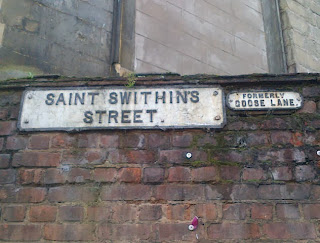
If both the spirit of a place & names are important to witches, then surely the street names of a place are important. I don't think I commented when I posted on Worcester before that I love the city's olde worlde street names. I also love the fact that many of them have another name by which the street was formerly known. I have searched without success for why & when this happened, so this will have to be a picture-heavy post & let the signs speak for themselves.
------------------