Tuesday, January 28, 2014

The city by night

Perhaps I'd better start this post by at least talking about what night means, & what it may mean to the various entities we may mean on our travels through a city. It is important not to forget the complete upheaval to human life that was caused by the Industrial Revolution, which is what marks the dividing line between the modern world in a form we would recognise, & the pre-industrial world so beloved of some pagans. I've heard a rumour that there's a joke in the saying about country people getting up with the cows & going to bed with the chickens (it may even be the other way round), but that is how people live if they don't have reliable light out of hours & are not shoehorned into the regular hours demanded by contractual employment.
Of course there is the huge divide in the English language of whether you call your evening meal tea or dinner; personally I come down on the side of calling it tea if it's earlier & dinner if it's later. I'm not overly attached to this distinction & it only appears here because eating later in the evening is a newish post-Industrial Revolution thing. The point of this is that in the past couple of hundred years a major disjoint in the way people live has occurred.
Cities, of course, always existed, but they have not been unaffected by the changes wrought by time, & often a relatively short period of time has marked the change. For example on the west side of Birmingham, as recently as the beginning of the nineteenth century the Hagley Road was open fields & Bearwood was a literal wood. So the spirits of a city may actually be terribly confused by the things that have happened, & night in the city, as with the evening meal, may happen at different times for different beings, & I don't just mean the ones who stay up clubbing all night.
I've actually been beating the streets of Birmingham for a long time; when you do that the spirit of a city looks at you & interacts with you in a different way from if you're just visiting. It remains that the best time to contact the spirit(s) of a place in detail is at night, define it as you will. Common sense precautions are of course necessary against some incarnate spirits, but I do think it's true that creatures of the night see a witch & even if they don't know what you are, recognise trouble staring them in the face.
This evening I started off in the markets, wandered towards the source of the Rea, passed the coach station, did some Digbeth back streets, wandered on Fazeley Street a little & went back into the city via Eastside. This is actually the older city centre than the present one, & is the setting for some major hot spots & energy centres. I like the feel of Digbeth, myself, it's straightforward, & I love the way you can turn a corner & come out into the old Birmingham.
Fazeley Street, on the other hand, freaks even me out at any time of the day or night. Today I had a distinct impression of being watched, & by some entity that definitely didn't want me to be there. From there up to, oh, Moor Street, I don't like the energies at all, except for one spot. I get this terrible sense of sadness there, & I don't think it's for nothing it's remained undeveloped until the city park opened. On the edge of the city park is what remains of the Park Street graveyard, which was opened as an overflow from St Martin's in 1807. It's really quite incongruent to be walking through a park & find a graveyard at the other end. Over Park Street is a wrecked pub I like, & that despite its appearance has been open since 2000.
I have to end with a picture to prove that Birmingham has some quaint street names. Paternoster Row dates from the 1870s, & was named after the Paternoster Row in London, since it had the same association with the printing industry. Of course it is not old enough to have the previous association of London's Paternoster Row, which was making rosaries - Paternoster is Latin for Our Father & refers to the beads to say the prayer on - & other Catholic tat. It is, however, friendly, despite that corner of the city being completely derelict if not actually flattened.
------------------

Janet & Stewart Farrar at home

I found this picture somewhere on the internet (sorry I've lost where) & since I love it more the more I see it, I simply had to post it here.
I think I commented before on a video of one of their initiations, that I love the way the Wiccans of the 1970s tend to be pictured doing ritual in their own home. Well, that's where witches do do a lot of ritual, isn't it? In the video I talked about Janet is shown instructing the new initiate & Stewart is pictured in the background listening while sitting in an armchair smoking a fag. That's such a witch thing, don't you think?
I love that this picture shows Stewart's desk setup, presumably in the 1970s. I love the wallpaper. I love the heterogeneous collection of pictures & ornaments. I love the worn labels on the filing cabinet drawers. I love the battered typewriter, which has got 'old faithful' written all over it. This is plainly the scene where Stewart wrote the books & articles that brought in the daily bread.
But here's what I love the best - Stewart (if not Janet, she's too young to have the smoker look) clearly smoked. You can see the evidence in the bottom left hand corner. He smoked Rothmans, which to me is a surprisingly trendy choice for the seventies. I've obviously misjudged him - I'd've expected him to smoke a brand like Senior Service or Park Drive. And here's the best bit, which makes the picture perfect for me. I *really* appreciate this touch. On the ashtray are two nub ends, & one half-smoked cigarette. And yes, your eyes don't deceive you, it's in a holder! I loooove the image of a foremost exponent of the witch religion of the time, smoking cigarettes in a holder!
------------------

Saturday, January 25, 2014

A Hedge in the Desert

I suspect that Islam is the only major religion that has never had a monastic movement, by which I mean a withdrawal from 'the market place' into 'the desert'. (Islam has more than enough provision for a para-monastic life to make a monastic movement unnecessary.) I gather that modern scholarship is undercovering a history of urban monasticism for the early Christians, but the movement tends to be associated ultimately with the desert, understood either literally or figuratively.
We witches of course don't have a monastic movement, but I am realising that the ever-fruitful image of the hedge exactly parallels the idea of the desert in Christian monasticism - a place where you are essentially alone, what comes next is unknown, you are faced with your worst demons & fears, & even life itself can be in doubt.
The fruits of entry into the desert/hedge are emerging transformed. As non-monotheists we wouldn't interpret this as transformation in conformity with Jesus, but rather interpret the transformation in epic terms of conflict & struggle. There be dragons in the hedge, me dears. The other change is that the world outside the hedge looks different seen from the perspective of the hedge, & it's an experience that cannot be undone.
The experience can of course be triggered by any of life's major events or emotions - bereavement, loneliness, abandonment, depression & other illnesses. As witches we believe that everything holds the seeds of its polar opposite, so it is in these events that life is transformed, & help is always at hand. When the witch is ready the thing needed appears.
Hold on to your hats, we're in for a bumpy ride.
------------------

Friday, January 24, 2014

Urban Grimoire: A spell for use on banks & other bureaucracies

Regular readers of the Hound's exploits & opinions will remember that I stopped a cheque to a plumber in December. At least I didn't but I thought the bank had, only to find today that they didn't & they've both been paid out.

Preparation for the ritual: it is essential that you go in to a branch of the bank for this one. It may be necessary to take sandwiches & a flask. Being catheterised may be extreme but excretory functions should be seen to before. They will almost certainly offer you coffee at some point, though, which is the sign the ritual is working.

Ritual apparel: the authorities are divided on this one. Some feel it's best to dress as the entities you're dealing with. My personal opinion is that it's best to wear whatever you wear to work, so that you can stress how this visit has inconvenienced you.

Mindset: The mindset for this one can be difficult to achieve, since you will almost certainly be feeling wound up, & completely certainly dealing with a bureaucracy that will be trying to get you to go away. The mindset is Nice. Not quite slipping over into apologetic or snarling, & if you find yourself slipping into one of those, it is essential to keep muttering the mantra 'I'm sure we can sort this out'. This may seem uncharacteristically conciliatory for the Hound, but it's how you say it that matters. You have to say one thing, but you have to mean *i'm sure you can sort this out*.

Timing for the ritual
A busy time of day. Lunchtime or just before closing is always good.

Opening to the ritual.
Approach the counter. Wait in line calmly, doing nothing to draw attention to yourself.

The demons of the outer circle
When called approach the counter smiling & state the problem clearly & calmly, without emotion, but making sure that the problem, whose responsibility it is, & how it is going to be resolved, are clear in your mind. attempts may be made to persuade you to sort it yourself, usually involving miriad phone calls. Bring yourself back to the required state of mind & state the problem & required solution again. Since the demons who guard the outer portals of the institution are always quite junior ones, they should at this point pass you on to someone senior.

Invocation in the triangle
At this point, you must under no circumstances deal with the entity that approaches you, at the counter. You must make sure a private room (the Lesser Key of Solomon calls this the triangle, but we know what they mean really) is the venue for this. Smile & say you'd rather not trumpet your business for everyone to hear.
Further attempts to get rid of the problem may be made. Bat them off smiling, & at this point a litany will take place. I repeat that at any point an offer of a cup of tea or coffee, or the entity leaving the triangle, are signs the ritual is working.

The Litany
The entity: 'I'll tell you what you can do...'
The Magician: 'No you won't, you'll tell me what you're going to do.'
The entity: 'Will you speak to..'
The Magician: 'No, you will.'
The entity: 'If you ring this number...'
The Magician: 'I'm not going to ring up that number, you're going to do it since it's the bank that's buggered it up.'
The entity: 'It would be much quicker for us if you...'
The Magician: 'I have no intention of lifting a finger to sort this since it's not of my doing.'

Up till now you have been dealing with a relatively low-level entity. The one I got was of the subset called Flash Harry. It was plain that while he was dead impressed with himself for working in a bank he had no real power nor ability, & frankly not the first idea what to do, which is why it's important to battle your way through the lower levels of the hierarchy without negotiating. At this point the entity will disappear to be replaced by a more senior demon. At this point you must on no account leave the triangle, much of your power resides in you occupying their essential retail space & refusing to leave.

You may have to repeat the litany as above. Don't forget senior demons get there by eating junior demons, you've already had a couple of them for dinner, so the senior demon will now begin to see you for what you are: a serious competitor to the title of Queen. He or she will also be keen that you perceive them as competent & reasonable, so will sometimes even make a crack about their junior. You must retain what you want in your mind & be prepared to repeat it several times again, but essentially once you've got the senior demon you're already marked down as Trouble. This is why it is essential at the beginning to be clear on what you want: if it's clear & reasonable they may even start doing it for you to get rid of you.

There are other demons in the hierarchy that can be invoked if your attempts fail, right up to the demon called Financial Services Ombudsman.
------------------

The Catholic Church and the United Nations Revisited

I've been meaning to post since Vatican representatives were summoned to Geneva to be questioned. I did a google news search today using search terms 'Vatican' & 'UN', & this remains the main news item. Of course except for the Catholic Register, which headlines 'Vatican Observer Calls for Concrete Steps Towards Peace in Syria' - far be it from me to suggest that this is a psychological mechanism to go, Look! There's trouble elsewhere in the world!
The 'secular' media reports it differently:
'The Vatican faced blistering criticism from a United Nations committee Thursday over allegations it protected pedophile priests at the expense of victims in what constituted a worldwide sex abuse scandal. [...] The Vatican insists it is not responsible for the actions of priests, who it says are not its employees but citizens of their own countries.' (http://worldnews.nbcnews.com/_news/2014/01/16/22324032-un-slams-vatican-for-efforts-to-cover-up-pedophile-priests-in-sex-abuse-scandal)
Despite continuing protestations of having no responsibility for the behaviour of its clergy, the Vatican claims to 'get it'. The protestations clearly indicate they don't, since the basis on which they claim not to be responsible for their clergy is a legal loophole as the clergy are not paid a salary so are not technically employees. Obviously when the Vatican produced guidelines in the 1960s instructing bishops to prevent 'scandal' at all costs, they didn't have any responsibility. The following quote is about what the Vatican is doing to prevent further abuse (in the interests of balance I'll state now that this is actually from a news item criticising the UN for not handling its own sex scandals);
'In December 2013, after refusing a U.N. request for information on alleged sexual abuse cases involving the clergy, Pope Francis announced through Cardinal Sean O�Malley, the archbishop of Boston, the decision by the Vatican to set up a child sex-abuse committee involving a panel of experts charged with producing guidelines of conduct for Catholic clergy and church officials.' (http://mobile.wnd.com/2014/01/pot-kettle-black-u-n-grills-vatican-over-sex/)
How many decades too late? When I posted about the UN & the Vatican before I commented that any respectable religious organisation should be ashamed to think of itself being investigated by the UN, given the organisation's usual remit. Yet they've even signed up to UN conventions, despite not then following up their duties under these conventions.
Here's the real problem: the Catholic Church sees itself as a monarchy, one in which everything is geared towards the defence of the monarch, who can be interpreted as (visibly) the Pope, or (invisibly) Jesus. Where they get this from is taking on the pomp & ceremony of the Roman Empire, & hence the fuss in some quarters about the Pope's humble act.
This is also why the Catholic Church ignores appeals by reasonable people to act sensibly & protect children - these people & their reasonable requests don't matter in the monarchy & never will. The relatively few priests kicked out - some of them with a pension - for abuse are to try to keep the ravening wolf of the secular world from the door. Hence why they are so difficult to deal with - the best advocates for clergy abuse victims are former clergy, who will know how the system works. They church will also feel free to ignore the United Nations, since that is a mere intergovernmental organisation.
This clash is therefore as much of a culture clash as anything. You will have correctly divined that I like anything that will bring abusers & those who protect them down with a bang. The first step, as always in witchcraft, is to name to problem, to know that this is the problem, & to continue to hold on to that as the problem unless disinterested evidence to the contrary comes to light.
From a witch point of view, what interests me about the Catholic Church thing, is that since they clearly do not get it, they plainly will continue to do the same strategies of denial-cover-evasion & these are precisely the strategies that will continue to get them into trouble, which is why awareness of how these people work is so important. In the modern world, having abusing clergy would not get them into trouble if they immediately involved the police, but these people do not live in the modern world & think they can retreat into their monarchy.
And in case anyone feels shocked at my evident satisfaction at these people's continuing downfall, well, carry on, I think this is wonderful. I was talking to a friend who is a Benedictine monk recently, who expressed some pity for the 'hard time' that the Ealing Abbey community have had. Hard time? Hard time? No, don't seem to have heard about it. Looking fools for presiding over a hotbed of paedophilia, including having a former abbot on the run from the police, is not having a hard time. The fear & destruction caused by abuse is having a hard time, claiming not to know about things is denial. And thus the pattern repeats itself.
But here's what happens, & I'll use Ealing Abbey as a microcosm of the Catholic Church to describe it. There are two sorts of men who will now join a community in their position: the first, namely those will say to themselves 'it's sorted now, it's not like it was,' are already in the denial mentality & thus will perpetuate the pattern, *if* abuse continues in the future so it will just continue.
The other sort are the people the church should be really wary of. My opinion is that the relatively high scrutiny under which Catholic clergy are no doubt assessed these days will actually attract people with issues. Leaving aside the tendency to let the guard down after a time, & the tendency to take anyone if an institute is desperate enough, given both the cunning with which paedophiles can convince others everything's OK, & the hoops they leap to to persuade themselves they're OK, nothing would surprise me.
You will also note that the report of the Vatican visitation of Ealing Abbey has not been published, the nearest I can find is a letter on the Westminster diocese's website that doesn't say a great deal (http://rcdow.org.uk/news/apostolic-visitation-to-ealing-abbey/). The message is clearly that everything continues in the kingdom. This is how kingdoms work: everyone's happiness is dependent on the continuing existence of the king. This is exactly the same as what's happening in the rest of the Catholic church. Any person appointed a bishop now who is in the their right mind would go through the diocese's secret archive & review all their clergy's history.
I'll leave it to their imagination whether this is actually happening, I don't think these people are *very* likely to take hints from the world outside!
------------------
Wednesday, January 22, 2014

Spirit of Place: Shrewsbury & Grope Lane

'Witches are people who look up,' says (I think) Granny Weatherwax somewhere, which is interpreted in its context to mean witches look up from the daily round to think about its deeper meaning. After the success of looking up in Worcester yesterday, I was hoping that doing the same in Shrewsbury would pay off, but unfortunately the street names in Shrewsbury are much less quaint.
They don't even have another little plaque underneath to say what they used to be called, as they do in Worcester, which is a pity, because the case of Grope Lane would certainly be interesting:
'A street called Grope Countelane existed in Shrewsbury as recently as 1561, connecting the town's two principal marketplaces. At some date unrecorded the street was renamed Grope Lane, a name it has retained. In Thomas Phillips' History and Antiquities of Shrewsbury (1799) the author is explicit in his understanding of the origin of the name as a place of "scandalous lewdness and venery", but Archdeacon Hugh Owen's Some account of the ancient and present state of Shrewsbury (1808) describes it as "called Grope, or the Dark Lane". As a result of these differing accounts, some local tour guides attribute the name to "feeling one's way along a dark and narrow thoroughfare".' (http://en.m.wikipedia.org/wiki/Gropecunt_Lane)
The latter attempt at derivation is of course delicate nonsense: Grope Lane is in the regular place (in the town centre, near the market) for a place of prostitution advertised in mediaeval fashion by the name of the street. In fact there were loads of them:
'Gropecunt Lane /ˈɡroʊpkʌnt ˈleɪn/ was a street name found in English towns and cities during the Middle Ages, believed to be a reference to the prostitution centred on those areas; it was normal practice for a medieval street name to reflect the street's function or the economic activity taking place within it. Gropecunt, the earliest known use of which is in about 1230, appears to have been derived as a compound of the words grope and cunt. Streets with that name were often in the busiest parts of medieval towns and cities, and at least one appears to have been an important thoroughfare.' (http://en.m.wikipedia.org/wiki/Gropecunt_Lane)
The 'groping in the dark' tale is trotted out on the Shrewbury Tourist Information website (http://www.shrewsburyguide.info/shrewsbury_tour/tour_02.shtml) with a denial that there is any ruder meaning, but there was another man photgraphing the sign when I was, who found it hilarious. I didn't think this would turn into a 'spirit of place' post of any depth, but perhaps it has, if these two competing explanations for 'grope' represent different facets of the town's spirit. On the other hand, the Love Shrewsbury website is very proud that this is the last surviving remnant of 'Grope' in the country (http://www.loveshrewsbury.com/article/history-lesson-shrewsburys-town-crier). As it happens it seems the prostitution derivation is supported by the facts, as reported by at least one academic historian (http://www.telegraph.co.uk/news/newstopics/howaboutthat/5864981/Street-names-date-back-to-brothels-and-red-light-districts.html) so this may well also be one of those posts about the phenomenon of people who simply will not see what's in front of their own faces!
------------------

Tuesday, January 21, 2014

Spirit of Place: Worcester Street Names

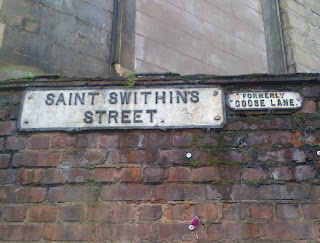
If both the spirit of a place & names are important to witches, then surely the street names of a place are important. I don't think I commented when I posted on Worcester before that I love the city's olde worlde street names. I also love the fact that many of them have another name by which the street was formerly known. I have searched without success for why & when this happened, so this will have to be a picture-heavy post & let the signs speak for themselves.
------------------