Monday, December 31, 2012

Happy new year

I'm looking forward to 2013: 2011 was a living nightmare, my year card was the Hermit, and it don't feel good. This year loads of stuff has changed since my year card was the Wheel of Fortune. This coming year my card is Strength: one handed pull ups here we come!
I can't resist ending the year on a weird note: the pic is of the Miraculous Lactation of St Bernard of Clairvaux. The legend goes thusly:
Based on one of the later legends of the great Cistercian Abbot Saint Bernard, he was reportedly praying one day in 1146 before a statue of the Virgin Mary in Speyer Cathedral. In his prayer he asked the Virgin to "Show that you are a mother..." (Monstra te esse matrem). The statue suddenly came alive and squirted milk on Bernard's lips. In this mystical encounter Bernard becomes a spiritual son of Mary sharing a kinship with Christ who was also nourished by Mary's milk.
From the Middle Ages through the Baroque period, much theological and pictorial attention was made on the subjects of Christ's blood and Mary's milk. By the Blood of Christ one gained redemption. Mary's milk became, on the other hand, a symbol of nourishment and hope on that road to salvation. Source
Even before the advent of Freudian theory I don't see how anyone could see it just wasn't right to have the Mother of your God squirting breast milk into your mouth. And people think it's weird when in vodou they get married to the Lwa!

Friday, December 28, 2012

Not forgetting

I am slightly bothered by the 'never forget the burning times' mentality: leaving aside the fact that they didn't happen. I found myself falling into it when I tried to synchronise pictures from a file on my laptop called 'witches' to my mp3 player and it just wouldn't do it. All other pictures it will, but none from that file. I found myself thinking that I was being persecuted for being a witch.
Of course this isn't so. However of course this pap-victim mentality can be essential at times. We humans tend to remember things selectively: we paint our own actions in a rosy glow, and because we don't want to go through life perpetually surrounded by conflict we tend to forgive and forget the actions of others. If it be your will, forgive by all means, but be careful about forgetting. The message of hope we have for the world is taht our actions cannot be undone, they pursue us beyond this life, we *must* live with the repercussions - 'karma' is too loaded, because sometimes shit just happens - of our actions. When people forget this they then tend to think they can get away scot free.
This is where the witch comes in. My own craft teacher told me that she thought we are here to create the scenarios for people to correct their own karma/repercussions. I am only now beginning to understand this: it's one of the reasons we wear black, because we absorb the actions around us and record them in a way. This is why some witches go off their heads, because they're not managing the amount of data they're processing: it is essential to turn off from this and select what data to delete permanently sometimes.
You will remember that a while ago I had an almighty run-in with someone at work: this actually took the form of not letting her forget things that she had done to people. She had artfully erased everything from her memory - and very interestingly was very ready to drop her former best chum in it for making people's lives a living hell. The outcome of my replaying her actions to her has been even better than I expected. It has actually caused the fruition of endless spells cast by myself and another over several years. In fact it has caused the whole debt/burden/karma to come back to her.
Strangely I now find I don't have to forgive her. I don't feel the need. It's done. If I hadn't made a point of remembering, recalling, speaking, it wouldn't be dealt with at all. But hey, that's what witches are for. Everyone needs a witch in their lives, it's just some people don't realise it - and some of them are even witches!

Sunday, December 23, 2012

Happy Winterval

Winterval is what Birmingham City Council called the holiday in December some years ago, intending to offend no-one but merely getting laughed off the face of the earth. Not quite as much as when they sent out literature with picture of Birmingham Alabama instead of this one: they claimed it was 'generic skyline' but it was just too much to have been by chance. Whatever you want to call this holiday (I used to call it Modresnacht, but that's now too close to the bone), have a good one.
I've prepared as only I know how, by going for a sauna. I now have skin like a baby's bum, & more than that I'm not saying.
------------------

Thursday, December 20, 2012

Beware the hooded ones

Hecate has a way of claiming you for herself. She does wander in and out of people's lives, but notoriously once you are her priest(ess) it is unusual to work much or at all with any other divinity. That said, she does usher in others from time to time, and I have a very soft spot for the genii cucullati, or hooded spirits (although perhaps the first picture in this post would more properly be labelled a godling by archaeologists). This is what the wonderful wikipedia has to say about them:
The Hooded Spirits or Genii Cucullati are figures found in religious sculpture across the Romano-Celtic region from Britain to Pannonia, depicted as "cloaked scurrying figures carved in an almost abstract manner" (Henig, 62). They are found with a particular concentration in the Rhineland (Hutton). In Britain they tend to be found in a triple deity form, which seems to be specific to the British representations (De la Bedoyère).
The hooded cape was especially associated with Gauls or Celts during the Roman period. The hooded health god was known as Telesphorus specifically and may have originated as a Greco-Gallic syncretism with the Galatians in Anatolia in the 3rd century BC.
The religious significance of these figures is still somewhat unclear, since no inscriptions have been found with them in this British context (De la Bedoyère). There are, however, indications that they may be fertility spirits of some kind. Ronald Hutton argues that in some cases they are carrying shapes that can be seen as eggs, symbolizing life and rebirth, while Graham Webster has argued that the curved hoods are similar in many ways to contemporary Roman curved phallus stones. However, several of these figures also seem to carry swords or daggers, and Henig discusses them in the context of warrior cults.
Guy de la Bédoyère also warns against reading too much in to size differences or natures in the figures, which have been used to promote theories of different roles for the three figures, arguing that at the skill level of most of the carvings, small differences in size are more likely to be hit-and-miss consequences, and pointing out that experimental archaeology has shown hooded figures one of the easiest sets of figures to carve. Source
I have been thinking recently about the meaning of hoods. Of course the word often nowadays appears as an abbreviation for (usually violent and otherwise disreputable) neighbourhood. People wear hoods for all sorts of reasons, frequently for protection from the elements, implying that you are going to be spending time in the wilds, or at least out of doors. You may need protection from the elements because of the nature of your work: it implies you are a person who has to work in all weathers and don't just sit by the fire employing somebody else to slaughter the animals for you.
My Witchcraft 101 class's graduation
Recently 'hoodie' has come to mean a generally disreputable person. Apparently these people hang around in gangs and frighten people. Personally I feel that actually the man made fibres of scally clothing, dark colours, and hoods make the perfect clothing for witches who may feel the need to frequent crossroads or graveyards in the middle of the night, and feel the need to vanish into the shadows if they're found doing something which while not being illegal would look extremely odd and be embarrassing to explain to Lily Law. I once had an encounter with some lads trying to be goths in a graveyard. I had gone for some gravedust because there is a particularly sympathetic grave in that particular graveyard, and the people's name is actually my mother's maiden name. It was a cold and misty night, and I had on black trainer, black trackies, a black hoodie with the hood up, a black scarf, and black gloves. They were sitting round in a tree drinking from a bottle and they didn't see me coming until I turned suddenly and the light from a nearby street lamp caught my face. Would you believe they ran away screaming? Call yourselves goths?
A scene from the Birmingham riots
Of course all wearing the same is a major tactic of peaceful protestors and rioters. It makes it difficult to differentiate an individual to single out, and it is even more difficult to pull up a great crowd. Perhaps this explains why the hoodie look is considered slightly scary, with overtones of rebellion and antisocial behaviour, and of course wearing black has many cultural overtones, perhaps the most obvious albeit ignorant one among the illiterati being that it is associated with 'satanism'. How can these people not understand that your real satanists will wear what they damn well please, that is the point?!
Buckfast tonic wine: made by hoodies for hoodies

I feel that the overtones of dodginess, outdoorsiness, outsiderness, and generally being on the edge that hoodies have are just too close to the ambivalent overtones of the classical witch figure to be ignored. These creatures, even the original divine hoodies, are too slippery to be grasped and so must be controlled. Exactly the emotions the word 'witch' still brings up in many people. This is a curious synchronicity which has only recently struck me. Even the more 'kinky' elements of the traditional witch figure such as that of 'enchantress' or ability to transform from a hag into a pretty young thing and seduce unsuspecting men, have survived into the whole gay scene around the scally/chav/ned thing!

Commentary on the Charge of the Goddess 22: and ye shall dance, sing, feast, make music, and love, all in my praise.

Sources and Influences

Ye Bok of Ye Arte Magical: And ye shall dance, sing, feast make music, and love, all in my praise.

Leland Aradia: And thus shall it be done: all shall sit down to the supper all naked, men and women, and, the feast over, they shall dance, sing, make music, and then love in the darkness, with all the lights extinguished; for it is the Spirit of Diana who extinguishes them, and so they will dance and make music in her praise. (No Italian text or verse numbers)

The passage from Aradia does not follow on from the passage quoted previously, Aradia’s speech to the witches, but occurs in the next section, on the Sabbath.

Crowley Editorial to The ‘Blue’ Equinox: Christianity has destroyed the joyful celebrations, characterized by music, dancing, feasting, and making love.

Thealogy

    There is a curious synchronicity between the passage of Aradia and the passage from Crowley; Gardner takes the passage directly from Aradia, mixes it (consciously or subconsciously) with ideas which may be found in Crowley, and the idea once again emerges in a new form in Wicca. These aspects of Wicca may simply appear to be some of its more countercultural aspects, but Gardner transforms them into parts of the magico-religious technology by which witches practise their religion, the point of which is freedom, signified by nudity, and achieved using these methods.
    For Crowley the significance of taking pleasure was found in the passing of the age of the old gods of servitude, and the arrival of the new age of Thelema, in which every man and every woman is a star. The seeking and doing of the True Will means there is no longer any place for gloominess and a consciousness of sin, which are replaced by the mastery of all. He writes thus (on the two pages of The Law of Liberty from which Gardner took so many of the quotations used in the Charge):
‘...Live as the kings and princes, crowned and uncrowned, of this world, have always lived, as masters always live; but let it not be self-indulgence; make your self-indulgence your religion.
‘When you drink and dance and take delight, you are not being “immoral,” you are not “risking your immortal soul”; you are fulfilling the precepts of our holy religion – provided only that you remember to regard your actions in this light. Do not lower yourself and destroy and cheapen your pleasure by leaving out the supreme joy, the consciousness of the Peace that passeth understanding.’  (Aleister Crowley: The Equinox Vol. 3, No. 1, March 1919 (The Blue Equinox). Weiser Books, San Francisco, 2007, p.48)
    Gardner takes the joy both of the witch-cult as pictured in Aradia and that as viewed in Thelema and includes dancing, feasting, and making love as rituals of Wicca. He changes the emphasis slightly by making the feast in Wiccan ritual a sacramental communion, which he is at pains to emphasise is not a satire on Christian communion, stating that they took it from us (Gerald Gardner: The Meaning of Witchcraft. Weiser Books, York Beach, 2004.).  The feast also appears as part of the witch-cult’s rituals in Aradia, where it is seen as more of a magical act than it is in Wicca, since the meal to make the bread is conjured to make it the body of Aradia (Mario Pazzaglini and Dina Pazzaglini (editors): Aradia, or the Gospel of the Witches. Phoenix Publishing, Blaine, 1998.).
Making love as a religious ritual is transformed in Wicca into the major sacrament, the Great Rite, where man and woman as the Goddess and God are united in the major mystery of fertility and creation celebrated in Wicca.
Dancing and singing are also transformed in Wicca into some of the eight ways to raise the power by which witches create what they need: dancing speaks for itself, but singing becomes the repetitive chanting by which witches build power. So dancing, singing, feasting, making music and love, rather than merely being the hallmarks of the liberal rituals of a countercultural religion, are transformed in Wicca into a communion feast, a celebration of the major mystery of creative union in Wicca, and some aspects of the inner magical technology used by witches.
And not merely inner magical technology: once again it is important not to forget that these words are being spoken by the Goddess of the witches drawn down into the body of the High Priestess. These things are done in her praise, as part of our co-creative work of being the Goddess, incarnating the Goddess in us, helping others to recognise their inner Goddess, and manifesting the Goddess in the world around us.

Wednesday, December 19, 2012

Not cackling

To the moot last night (I'm the one in the hat). Sir Terence Pratchett writes that witches like to meet to make sure they're not 'cackling'. It would surely take a witch to recognise true cackling for what it is, but anyway a roaringly good moot happened. I do like it when the conversation starts off with double meanings and goes on until we suddenly find we've been locked in & nobody's noticed. The landlord wished us a 'happy Christmas, or whatever you have.'
------------------

Saturday, December 15, 2012

Coventry and modernism revisited, and Rod the God

Last night I was watching Danger Man & conceived the notion of an outing to Coventry today. The titles of that show so make me think of Coventry station: forty years ago they would both have summoned up the same idea of modern city sophistication, forward-looking & unhampered by the bonds of the past.
Recently in my reading about urban exploration on the internet (not doing it myself, I hasten to add, I might break a fingernail) I've come across a reason why modernism has ceded to postmodernism. A search for modern derelict, abandoned, loved/loathed buildings shows that they are precisely those buildings that embody an ideology whose time has passed. In Britain perhaps Park Hill flats in Sheffield would be the best example of that, although they, like the (in)famous Trellick Tower in London are in the throes of gentrification. Both of those were designed by architects and councils who wanted a better life *for other people*. It seems hoi polloi have rarely bought into modernism; albeit Park Hill was seen as heaven when new until the rot set in.
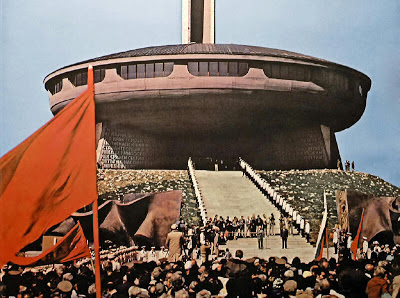
Modernism as the embodiment of someone else's ideology in Cold War western Europe may be seen in some relics is communist architecture in the former Eastern Europe, such as the former Communist Party headquarters in Bulgaria. From the west in the 1980s this must have had the appearance of regimentation, a closed system which allowed corruption & ultimately the Chernobyl disaster, a corruption & creeping decay hidden under the appearance of a bright new future. The communist headquarters had 'forget your past' in huge letters above the door: the exact opposite of what anyone in the west who wanted to avoid the menace from across the curtain would have wanted to do. The mosaics in the headquarters are drop dead gorgeous to my mind: extremely reminiscent of the sort of public art put up in the doomed underpasses of the post-war town planners' Britain. Once again the theme of regimentation & an enforced bright new future which doesn't really happen, appears. Also the brutalist/regimented/socialist/communalist ideology draws on motifs alien to us in the west. The person from whose blog come the last three images (acknowledgement: www.thebohemianblog.com) thinks that the final picture is a depiction of the pre-Christian Slav God Rod. It seems there is some debate about his standing in ancient pantheons, but in neo-pagan systems he has become a central deity. I don't think for an instant his name is pronounced to rhyme with 'god', but I have been unable to find the correct pronunciation online. To the inhabitants of western 'Christendom' modernism may therefore seem a heathen imposition of ungodly values & doomed. Ironic that since then not only has Western europe become increasingly post-Christian, but Christianity has had a real resurgence in the east, along with neo-paganism, and the full revelation of how corrupt western Christendom really is! The bigger picture is this: political systems come & go, they and religions have declines & resurgences. Our present realities can seem different in hindsight. By all means construct your future, but be careful not to forget your past because that is the source of the present. Even if we need to dis-member it to re-member it as an archaic future, it is essential not to deny it because it might just bite you on the bum.
------------------